
Picture a dolphin. Now think about one which’s twice the measurement of an individual.Around 16 million years in the past, a dolphin big cruised the depths of its watery area. But not like most trendy dolphins, its dwelling wasn’t an ocean; it lived in a freshwater lake in the Peruvian Amazon. And although there are Amazonian freshwater dolphin species alive at the moment, they aren’t shut kin to that ancient cetacean. Its closest dwelling relations are river dolphins dwelling greater than 6,000 miles away in South Asia, based on researchers who lately described the beforehand unknown extinct mammal.Analysis of the newly recognized ancient dolphin’s cranium advised paleontologists that its physique would have measured a minimum of 11 toes lengthy — making it about 20% to 25% larger than trendy river dolphins and the greatest identified freshwater dolphin.But the cranium, which measured about 27 inches lengthy, was incomplete, so the ancient dolphin might have been even bigger than that, the scientists reported March 20 in the journal Science Advances, revealed by the American Association for the Advancement of Science.What makes the discover much more distinctive is the perception it affords into the evolutionary historical past of freshwater dolphins, as these creatures are extraordinarily uncommon in the fossil report, the examine authors wrote. This is as a result of there are typically fewer particular person dolphins in freshwater ecosystems, and robust water currents usually stop fossils from preserving effectively.They referred to as the newfound species Pebanista yacuruna; the genus references Peru’s Pebas Formation, the place the fossil was discovered, and “yacuruna” is a time period for legendary aquatic folks of native legend, in the Indigenous Kichua language.“I feel it is a outstanding discovery, significantly provided that South America has one species of river dolphin that belongs to a totally totally different group of odontocetes (toothed whales),” mentioned Jorge Velez-Juarbe, an affiliate curator of marine mammals at the Natural History Museum of Los Angeles County, in an e mail.“(It) makes me surprise too what number of different information of extinct river dolphins are awaiting to be found,” Velez-Juarbe, who was not concerned in the analysis, advised CNN.‘Everybody freaked out’: Fossil options reveal uncommon discoverModern freshwater dolphins are identified for his or her extremely elongated noses, in contrast with marine dolphins’ stubbier snouts. There’s the South Asian river dolphin (Platanista genus) and the Amazon river dolphin (Inia genus), often known as the pink river dolphin, and the two teams embrace a number of species and subspecies.China’s Yangtze river dolphin (Lipotes vexillifer) represents a 3rd genus, however the species hasn’t been seen in the wild in 40 years and could also be extinct, based on the International Union for the Conservation of Nature (IUCN). In truth, all extant river dolphin species are endangered or critically endangered, the IUCN says.Researchers found the Amazonian dolphin fossil in 2018, close to the Napo River in Loreto, Peru. Lead examine writer Aldo Benites-Palomino, a doctoral candidate in the University of Zurich’s Department of Paleontology, had stopped to look at some strange-looking rocky fragments on the floor, he advised CNN. At the similar time, examine coauthor John J. Flynn, a curator of fossil mammals at the American Museum of Natural History in New York City, identified what seemed like a cranium jutting from an embankment. “I mentioned: ‘Hey, John, does this hook up with this piece that I’ve in my hand?’” Benites-Palomino recalled. What he held turned out to be a rostrum — the rounded tip of a nostril — from the embedded cranium. As they cleaned it up sufficient to see the shapes of tooth sockets, Benites-Palomino realized that they have been taking a look at one thing unusual.“We began screaming: ‘It’s a dolphin! It’s a dolphin!’” Benites-Palomino mentioned.At first, they thought it might transform an ancient relative of contemporary Amazonian river dolphins. But additional cleansing revealed that the measurement and form of the eye socket resembled that of South Asian river dolphins, which have a lot smaller eyes than their South American cousins.“That was a second the place all people freaked out, as a result of it wasn’t an Amazonian river dolphin,” Benites-Palomino mentioned. This advised the scientists that two varieties of dolphins had independently and at totally different occasions moved inland in the area.Digging up dolphin rangePlatanistoids — the group that features P. yacuruna and South Asia’s trendy river dolphins — have been widespread about 20 million years in the past. The ancestors of contemporary Amazonian river dolphins have been widespread in oceans about 10 million to six million years in the past, Benites-Palomino mentioned.Because each teams of cetaceans have been so numerous, some species probably ventured into river and lake ecosystems, searching for much less competitors for meals. This Amazonian freshwater surroundings was nutrient-rich and teeming with life, dwelling to crocodilians, turtles and fish, in addition to mammals comparable to sloths, rodents, ungulates and primates.“Overall, in these ecosystems ‘river dolphins’ might be thought-about as apex predators,” Velez-Juarbe mentioned. P. yacuruna was amongst the first wave of dolphins to check the waters in Amazonian rivers and lakes; a scarcity of predators in its new dwelling may clarify how the species developed to change into so giant, based on the examine. But environmental modifications like drought might have later doomed P. yacuruna and pushed it to extinction, opening the freshwater habitat to the ancestors of extant pink river dolphins.“We now know that this species was dwelling there in the previous, but additionally the Amazonia is essential for our extant Inia geoffrensis,” Benites-Palomino mentioned. “ highlights that it is a tremendously essential surroundings for the evolution of freshwater cetaceans.”P. yacuruna’s disappearance is a grim reminder that this essential surroundings is all too simply disrupted. Today, trendy Amazonian river dolphins face an unsure future, principally resulting from mercury air pollution from gold mining invading the meals chain, based on the World Wildlife Fund. The newfound fossil hints at the fragility of freshwater ecosystems and the vulnerability of their inhabitants — previous and current — to environmental modifications, whether or not such modifications are pure or human-made, Velez-Juarbe added.“Pebanista provides one other layer to the intricate evolutionary historical past of cetaceans and significantly ‘river dolphins,’ the few species that survive to current day are however the final remnants of teams that have been as soon as extra numerous.”
Picture a dolphin. Now think about one which’s twice the measurement of an individual.
Around 16 million years in the past, a dolphin big cruised the depths of its watery area. But not like most trendy dolphins, its dwelling wasn’t an ocean; it lived in a freshwater lake in the Peruvian Amazon. And although there are Amazonian freshwater dolphin species alive at the moment, they aren’t shut kin to that ancient cetacean. Its closest dwelling relations are river dolphins dwelling greater than 6,000 miles away in South Asia, based on researchers who lately described the beforehand unknown extinct mammal.
Analysis of the newly recognized ancient dolphin’s cranium advised paleontologists that its physique would have measured a minimum of 11 toes lengthy — making it about 20% to 25% larger than trendy river dolphins and the greatest identified freshwater dolphin.
But the cranium, which measured about 27 inches lengthy, was incomplete, so the ancient dolphin might have been even bigger than that, the scientists reported March 20 in the journal Science Advances, revealed by the American Association for the Advancement of Science.
What makes the discover much more distinctive is the perception it affords into the evolutionary historical past of freshwater dolphins, as these creatures are extraordinarily uncommon in the fossil report, the examine authors wrote. This is as a result of there are typically fewer particular person dolphins in freshwater ecosystems, and robust water currents usually stop fossils from preserving effectively.
They referred to as the newfound species Pebanista yacuruna; the genus references Peru’s Pebas Formation, the place the fossil was discovered, and “yacuruna” is a time period for legendary aquatic folks of native legend, in the Indigenous Kichua language.
“I feel it is a outstanding discovery, significantly provided that South America has one species of river dolphin that belongs to a totally totally different group of odontocetes (toothed whales),” mentioned Jorge Velez-Juarbe, an affiliate curator of marine mammals at the Natural History Museum of Los Angeles County, in an e mail.
“(It) makes me surprise too what number of different information of extinct river dolphins are awaiting to be found,” Velez-Juarbe, who was not concerned in the analysis, advised CNN.
‘Everybody freaked out’: Fossil options reveal uncommon discover
Modern freshwater dolphins are identified for his or her extremely elongated noses, in contrast with marine dolphins’ stubbier snouts. There’s the South Asian river dolphin (Platanista genus) and the Amazon river dolphin (Inia genus), often known as the pink river dolphin, and the two teams embrace a number of species and subspecies.
China’s Yangtze river dolphin (Lipotes vexillifer) represents a 3rd genus, however the species hasn’t been seen in the wild in 40 years and could also be extinct, based on the International Union for the Conservation of Nature (IUCN). In truth, all extant river dolphin species are endangered or critically endangered, the IUCN says.
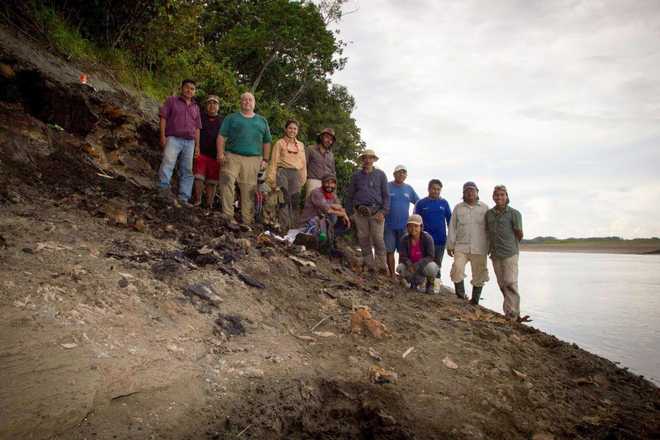
Researchers found the Amazonian dolphin fossil in 2018, close to the Napo River in Loreto, Peru. Lead examine writer Aldo Benites-Palomino, a doctoral candidate in the University of Zurich’s Department of Paleontology, had stopped to look at some strange-looking rocky fragments on the floor, he advised CNN. At the similar time, examine coauthor John J. Flynn, a curator of fossil mammals at the American Museum of Natural History in New York City, identified what seemed like a cranium jutting from an embankment.
“I mentioned: ‘Hey, John, does this hook up with this piece that I’ve in my hand?’” Benites-Palomino recalled. What he held turned out to be a rostrum — the rounded tip of a nostril — from the embedded cranium. As they cleaned it up sufficient to see the shapes of tooth sockets, Benites-Palomino realized that they have been taking a look at one thing unusual.
“We began screaming: ‘It’s a dolphin! It’s a dolphin!’” Benites-Palomino mentioned.
At first, they thought it might transform an ancient relative of contemporary Amazonian river dolphins. But additional cleansing revealed that the measurement and form of the eye socket resembled that of South Asian river dolphins, which have a lot smaller eyes than their South American cousins.
“That was a second the place all people freaked out, as a result of it wasn’t an Amazonian river dolphin,” Benites-Palomino mentioned. This advised the scientists that two varieties of dolphins had independently and at totally different occasions moved inland in the area.
Digging up dolphin range
Platanistoids — the group that features P. yacuruna and South Asia’s trendy river dolphins — have been widespread about 20 million years in the past. The ancestors of contemporary Amazonian river dolphins have been widespread in oceans about 10 million to six million years in the past, Benites-Palomino mentioned.
Because each teams of cetaceans have been so numerous, some species probably ventured into river and lake ecosystems, searching for much less competitors for meals. This Amazonian freshwater surroundings was nutrient-rich and teeming with life, dwelling to crocodilians, turtles and fish, in addition to mammals comparable to sloths, rodents, ungulates and primates.
“Overall, in these ecosystems ‘river dolphins’ might be thought-about as apex predators,” Velez-Juarbe mentioned.
P. yacuruna was amongst the first wave of dolphins to check the waters in Amazonian rivers and lakes; a scarcity of predators in its new dwelling may clarify how the species developed to change into so giant, based on the examine. But environmental modifications like drought might have later doomed P. yacuruna and pushed it to extinction, opening the freshwater habitat to the ancestors of extant pink river dolphins.
“We now know that this species was dwelling there in the previous, but additionally the Amazonia is essential for our extant Inia geoffrensis,” Benites-Palomino mentioned. “[The discovery] highlights that it is a tremendously essential surroundings for the evolution of freshwater cetaceans.”
P. yacuruna’s disappearance is a grim reminder that this essential surroundings is all too simply disrupted. Today, trendy Amazonian river dolphins face an unsure future, principally resulting from mercury air pollution from gold mining invading the meals chain, based on the World Wildlife Fund. The newfound fossil hints at the fragility of freshwater ecosystems and the vulnerability of their inhabitants — previous and current — to environmental modifications, whether or not such modifications are pure or human-made, Velez-Juarbe added.
“Pebanista provides one other layer to the intricate evolutionary historical past of cetaceans and significantly ‘river dolphins,’ the few species that survive to current day are however the final remnants of teams that have been as soon as extra numerous.”


