
A most severity vulnerability that permits hackers to hijack GitLab accounts with no consumer interplay required is now under active exploitation, federal authorities officers warned as knowledge confirmed that hundreds of customers had but to put in a patch launched in January.
A change GitLab carried out in May 2023 made it attainable for customers to provoke password modifications by way of hyperlinks despatched to secondary electronic mail addresses. The transfer was designed to allow resets when customers didn’t have entry to the e-mail handle used to determine the account. In January, GitLab disclosed that the characteristic allowed attackers to ship reset emails to accounts they managed and from there click on on the embedded hyperlink and take over the account.
While exploits require no consumer interplay, hijackings work solely towards accounts that aren’t configured to make use of multifactor authentication. Even with MFA, accounts remained susceptible to password resets, however the attackers finally are unable to entry the account, allowing the rightful proprietor to vary the reset password. The vulnerability, tracked as CVE-2023-7028, carries a severity score of 10 out of 10.
On Wednesday, the US Cybersecurity and Infrastructure Security Agency mentioned it’s conscious of “proof of active exploitation” and added the vulnerability to its listing of identified exploited vulnerabilities. CISA supplied no particulars concerning the in-the-wild assaults. A GitLab consultant declined to supply specifics concerning the active exploitation of the vulnerability.
The vulnerability, labeled as an improper entry management flaw, might pose a grave risk. GitLab software program sometimes has entry to a number of improvement environments belonging to customers. With the flexibility to entry them and surreptitiously introduce modifications, attackers might sabotage initiatives or plant backdoors that might infect anybody utilizing software program constructed within the compromised atmosphere. An instance of an identical provide chain assault is the one which hit SolarWinds in 2020 and pushed malware to greater than 18,000 of its prospects, 100 of whom obtained follow-on hacks. Other current examples of provide chain assaults are right here, right here, and right here.
These kinds of assaults are highly effective. By hacking a single, rigorously chosen goal, attackers achieve the means to contaminate hundreds of downstream customers, usually with out requiring them to take any motion in any respect.
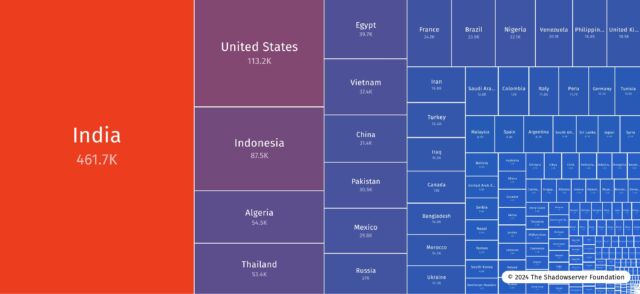
According to Internet scans carried out by safety group Shadowserver, greater than 2,100 IP addresses confirmed they have been internet hosting a number of susceptible GitLab situations.
Shadowserver
The largest focus of IP addresses was in India, adopted by the US, Indonesia, Algeria, and Thailand.
Shadowserver
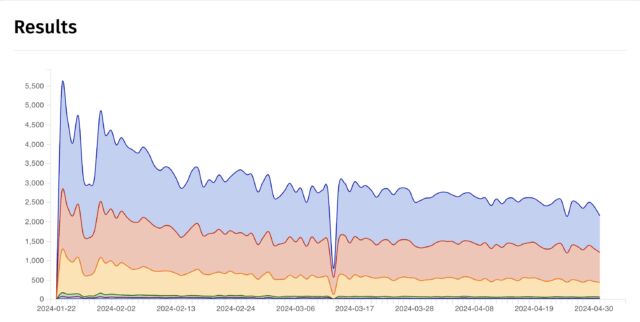
The variety of IP addresses displaying susceptible situations has fallen over time. Shadowserver exhibits that there have been greater than 5,300 addresses on January 22, one week after GitLab issued the patch.
Shadowserver
The vulnerability is classed as an improper entry management flaw.
CISA has ordered all civilian federal businesses which have but to patch the vulnerability to take action instantly. The company made no point out of MFA, however any GitLab customers who haven’t already executed so ought to allow it, ideally with a kind that complies with the FIDO business normal.
GitLab customers also needs to do not forget that patching does nothing to safe methods which have already been breached by way of exploits. GitLab has revealed incident response steering right here.


