
Airchat is a new social media app that encourages customers to “simply speak.”
A earlier model of Airchat was launched final 12 months, however the group — led by AngelList founder Naval Ravikant and former Tinder product exec Brian Norgard — rebuilt the app and relaunched it on iOS and Android yesterday. Currently invite-only, Airchat is already ranked #27 in social networking on Apple’s App Store.
Visually, Airchat ought to really feel fairly acquainted and intuitive, with the flexibility to observe different customers, scroll via a feed of posts, then reply to, like, and share these posts. The distinction is that the posts and replies are audio recordings, which the app then transcribes.
When you open Airchat, messages mechanically begin enjoying, and also you shortly cycle via them by swiping up and down. If you’re so inclined, you’ll be able to really pause the audio and simply learn text; customers may also share images and video. But audio appears to be what everybody’s targeted on, and what Ravikant describes as reworking the dynamic in comparison with text-based social apps.
After becoming a member of Airchat this morning, many of the posts I noticed have been in regards to the app itself, with Ravikant and Norgard answering questions and soliciting suggestions.
“Humans are all meant to get together with different people, it simply requires the pure voice,” Ravikant mentioned. “Online text-only media has given us this delusion that individuals can’t get alongside, however really everyone can get alongside.”
This isn’t the primary time tech startups have guess on voice as the subsequent large social media factor. But Airchat’s asynchronous, threaded posts make for a fairly totally different expertise than the dwell chat rooms that briefly flourished on Clubhouse and Twitter Spaces. Norgard argued that this method removes the stage fright barrier to taking part, as a result of “you’ll be able to take as many passes at composing a message on right here as you want, and no one is aware of.”
In reality, he mentioned that in conversations with early customers, the group discovered that “most people utilizing AirChat at present are very introverted and shy.”
Personally, I haven’t satisfied myself to submit something but. I used to be extra fascinated with seeing how others have been utilizing the app — plus, I’ve a love-hate relationship with the sound of my voice.
Still, there’s one thing to be mentioned for listening to Ravikant and Norgard clarify their imaginative and prescient, somewhat than simply studying the transcriptions, which may miss nuances of enthusiasm, intonation, and so forth. And I’m particularly curious to see how deadpan jokes and shitposting translate (or don’t) into audio.
I additionally battle a bit with the velocity. The app defaults to 2x audio playback, which I assumed sounded unnatural, significantly if the entire thought is fostering human connection. You can reset the velocity by holding down the pause button, however at 1x, I observed I’d begin skimming when listening to longer posts, then I’d normally skip forward earlier than listening to the total audio. But perhaps that’s tremendous.
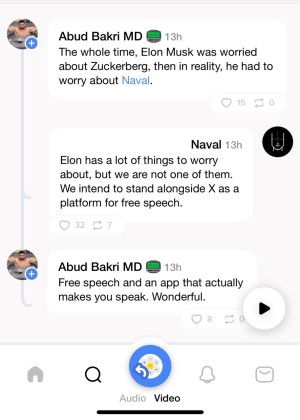
Meanwhile, Ravikant’s perception within the energy of voice to chop down on acrimony doesn’t essentially remove the necessity for content material moderation options. He mentioned the feed is powered by “some advanced guidelines around hiding spam and trolls and folks that you simply or they might not wish to hear from,” however as of publication he hadn’t not responded to a follow-up person query about content material moderation.
Asked about monetization — i.e., after we may begin seeing advertisements, audio or in any other case — Ravikant mentioned there’s “no monetization strain on the corporate in anyway.” (He described himself as “not the only investor” however “a large investor” within the firm.)
“I might care much less about monetization,” he mentioned. “We’ll run this factor on a shoestring if we have now to.”


