
At Mobile World Congress final week, the present flooring was abuzz with AI. It was the identical at CES two months earlier: The largest theme of the largest shopper tech present was that AI all of a sudden gave the impression to be half of each single product. But the hype could make it onerous to know what we must be enthusiastic about, what we must always concern and what we must always dismiss as a fad.
“Omnipresent … but in addition overwhelming.” That’s how CCS Insight Chief Analyst Ben Wood described the MWC second. “For many attendees, I felt it was quickly reaching ranges that risked inflicting AI fatigue.”
But there was a optimistic facet as nicely. Said Wood: “The most spectacular demos had been from firms exhibiting the advantages AI might provide quite than simply describing a service or a product as being AI-ready.”
At final 12 months’s MWC, the favored generative AI instrument ChatGPT was solely round 3 months previous, and on-device AI was largely a twinkle within the eye of the tech firms current. This 12 months, on-device was a actuality, and attendees — like me — might expertise it on the present flooring.
I received to expertise a number of demos that includes AI on units, and the most effective of them introduced synthetic intelligence to life in methods I’d by no means seen earlier than. In many instances, I might see that merchandise we’re already conversant in — from smartphones to automobiles — are getting a new lease on life due to AI, with some choices utilizing the know-how in distinctive methods to set themselves other than rivals. In different instances, new sorts of merchandise, like AI-focused wearables and robots, are rising which have the potential to displace what we all know and love.
Above all, it was clear that on-device AI is not a know-how for tomorrow’s world. It’s obtainable proper right here, proper now. And it might affect your choice as to what piece of know-how you purchase subsequent.
The age of AI telephones has arrived
One of my largest takeaways from MWC was that whereas all tech firms now have a raft of AI instruments at their disposal, most are selecting to deploy them in several methods.
Take smartphones. Samsung has developed Gauss, its personal giant language mannequin (the tech that underlies AI chatbots), to give attention to translation on the Galaxy S24, whereas Honor makes use of AI to incorporate eye monitoring on its newly unveiled Magic 6 Pro — which I received to check out at its sales space. Oppo and Xiaomi, in the meantime, each have on-device generative AI that they are making use of to cellphone cameras and photograph enhancing instruments.
It goes to indicate that we’re getting into a new interval of experimentation as tech firms determine what AI can do, and crucially the way it can enhance our expertise of utilizing their merchandise.
Samsung’s Y.J. Kim, an government vice chairman on the firm and head of its language AI staff, advised reporters at an MWC roundtable that Samsung thought deeply about what type of AI instruments it wished to ship to customers that will elevate the Galaxy S24 above the essential smartphone expertise we have come to count on. “We need to guarantee that clients will see some tangible advantages from their day-to-day use of the product or applied sciences that we develop,” he stated.
Conversely, there’s additionally some crossover in AI instruments between units as a result of of the companions these phone-makers share. As the maker of Android, the working system utilized by nearly all non-Apple telephones, Google is experimenting closely with AI options. These can be obtainable throughout telephones made by Samsung, Xiaomi, Oppo, Honor and a host of others.
Google used its presence at MWC this 12 months to speak about some of its lately launched AI options, like Circle to Search, a visible search instrument that permits you to draw a circle round one thing you see on display to seek for it.
Google’s Circle to Search was featured closely on the firm’s MWC sales space.
The different, much less seen accomplice that phone-makers have in frequent is chipmaker Qualcomm, whose chips had been in a complete spectrum of units at MWC this 12 months. Its Snapdragon 8 Gen 3 chip, introduced late in 2023, might be discovered in lots of of the telephones that at the moment are operating on-device generative AI.
It’s been solely a 12 months since Qualcomm first confirmed a primary demo of what generative AI on a cellphone may seem like. Now telephones packing this know-how are on sale, stated Ziad Asghar, who leads the corporate’s AI product roadmap.
“From our perspective, we’re the enablers,” stated Asghar. “Each and each one of our companions can select to commercialize with distinctive experiences that they suppose are extra essential for his or her finish shopper.”
At MWC, the corporate launched its AI Hub, which supplies builders entry to 75 plug-and-play generative AI fashions that they’ll decide and select from to use to their merchandise. That quantity will develop, and it means any firm making units with Qualcomm chips will be capable of add all kinds of AI options.

The Galaxy S24 Ultra exhibiting the brand new chat translation characteristic.
As nicely as deciding which AI options to develop, one of the subsequent large challenges phone-makers should sort out is easy methods to get AI onto their cheaper units. For now AI is primarily reserved for the top-end telephones — the Galaxy S24s of the world — however over time it will change. There can be a trickle-down impact the place this tech finally ends up on a wider vary of a firm’s units.
There will naturally be a distinction in high quality and pace between what the most costly and the most affordable units can do, stated Asghar, as is presently the case with a cellphone’s digital camera tech.
AI is altering how we work together with our units
AI enhancements to our telephones are all nicely and good, however already we’re seeing synthetic intelligence being utilized in ways in which have the ability to completely change how we work together with our units — in addition to probably altering what units we select to personal.
In addition to enabling firms to carry AI to their present system strains, Qualcomm’s tech is powering idea telephones just like the T Phone, created by Deutsche Telekom and Brain.AI. Together, these two have tapped Qualcomm’s chipset to completely reimagine your cellphone’s interface, creating an appless expertise that responds to you primarily based in your wants and the duty you are attempting to perform and generates, on the fly, no matter you see on display as you go.
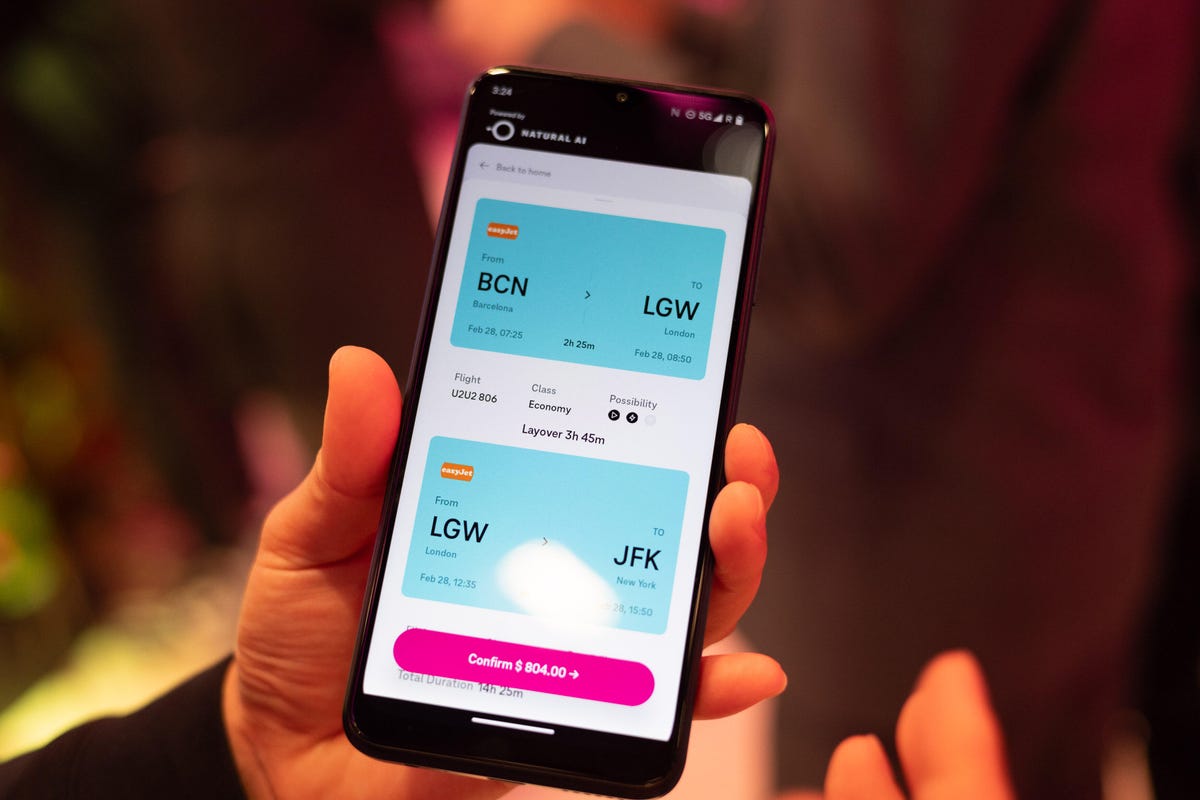
This interface was generated in actual time primarily based on a request to seek out flights.
In the demo I noticed at MWC, AI confirmed it has the potential to place an finish to the times of fixed app-swapping as you are attempting to make a plan or full a process. “It actually adjustments the way in which we interface with units and turns into a lot extra pure,” stated Asghar.
But, he stated, that is solely the start. He’d prefer to see the identical idea utilized to blended actuality glasses. He sees the massive profit of the AI in permitting new inputs by means of gesture, voice and imaginative and prescient that do not essentially depend on us tapping on a display. “Technology is far more attention-grabbing when it is probably not in your face, however it’s fixing the issues for you in an nearly invisible method,” he stated.
His phrases jogged my memory of a second within the MWC keynote presentation when Google DeepMind CEO Demis Hassabis requested an essential query. “In five-plus years time, is the cellphone even actually going to be the proper kind issue?” stated Hassabis. “There’s all kinds of superb issues to be invented.”
As we noticed at CES with the Rabbit R1 and at MWC with the Humane AI Pin, this stuff are beginning to develop into a actuality. In my demo with the AI Pin — a wearable system with no display that you just work together with by means of voice and contact — it was clear to me that AI is creating house for experimentation. It’s permitting us to ask what could succeed the cellphone because the dominant piece of know-how in our lives.
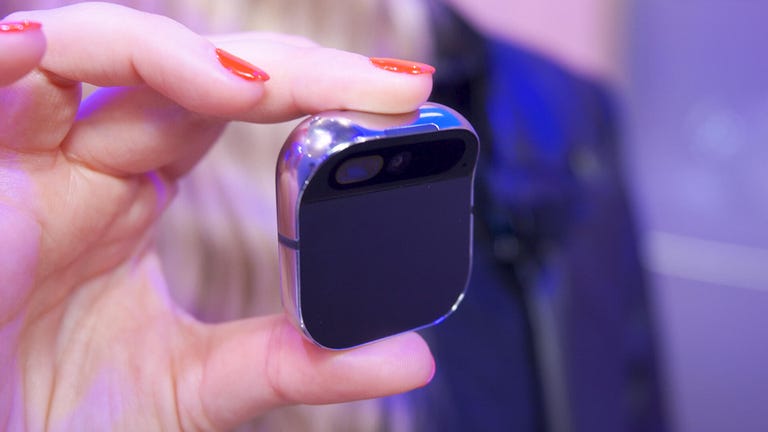
Watch this: Humane AI Pin Hands-On: Tiny Wearable Phonelet Beams Light Like R2-D2
It’s additionally opening up new prospects for tech that is been round awhile however for no matter motive hasn’t fairly struck a chord with shoppers and located success outdoors of area of interest use instances.
Many of us have now performed round with generative AI chatbots comparable to ChatGPT, and we’re more and more rising conversant in the concept of AI assistants. One firm, Integrit from South Korea, introduced a robotic to the present that demonstrated how we could work together with these companies in public settings, comparable to inns or shops. Its AI and robotics platform, Stella AI, options a giant, pebble-shaped show on a robotic arm that may swivel to deal with you immediately.
Where this differs from earlier robots I’ve encountered in customer support settings, comparable to the enduring Pepper, is that Stella is built-in with the most recent AI fashions, together with OpenAI’s GPT-4 and Meta’s Llama. This means it is succesful of having subtle conversations with individuals in many various languages.
Rather than that includes a humanoid robotic face like Pepper does, Stella makes use of generative AI to current a photorealistic human on its show. It’s fully attainable that individuals will really feel extra comfy interacting with a human, even one which is not actual, than a humanoid robotic, however it feels very early to know this for certain.
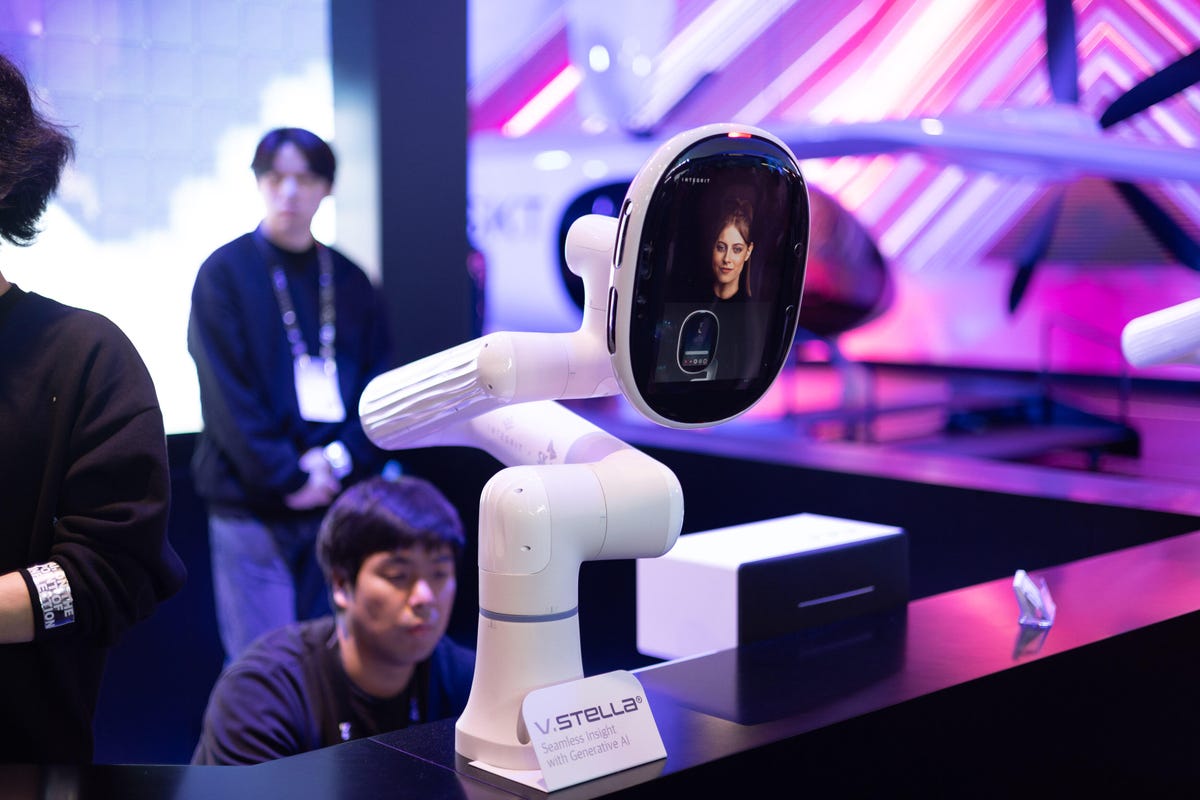
Integrit’s Stella combines robotics with AI in a recent means.
What is obvious is that that is just the start. This is the primary era of units to actually faucet into the ability of generative and interactive AI, and the floodgates at the moment are nicely and actually open.
“I feel we’ll look again at MWC 2024 as being a foundational 12 months for AI on linked units,” stated Wood, the CCS Insight analyst. “All the items of the jigsaw are falling into place to allow builders to begin innovating round AI to ship new experiences which is able to make our interactions with smartphones and PCs extra intuitive.”
If that is the start, I’m intrigued to examine again a 12 months from now to see how AI continues to vary our units. Hype apart, there’s a lot already occurring to be enthusiastic about.
Editors’ notice: CNET is utilizing an AI engine to assist create some tales. For extra, see this put up.


