
Getty Images
Threat actors carried out zero-day assaults that focused Windows customers with malware for more than a year before Microsoft fixed the vulnerability that made them doable, researchers mentioned Tuesday.
The vulnerability, current in each Windows 10 and 11, causes units to open Internet Explorer, a legacy browser that Microsoft decommissioned in 2022 after its growing older code base made it more and more inclined to exploits. Following the transfer, Windows made it tough, if not inconceivable, for regular actions to open the browser, which was first launched within the mid-Nineties.
Tricks outdated and new
Malicious code that exploits the vulnerability dates again to at the very least January 2023 and was circulating as lately as May this year, in accordance with the researchers who found the vulnerability and reported it to Microsoft. The firm fixed the vulnerability, tracked as CVE-2024-CVE-38112, on Tuesday as a part of its month-to-month patch launch program. The vulnerability, which resided within the MSHTML engine of Windows, carried a severity score of seven.0 out of 10.
The researchers from safety agency Check Point mentioned the assault code executed “novel (or beforehand unknown) methods to lure Windows customers for distant code execution.” A hyperlink that appeared to open a PDF file appended a .url extension to the tip of the file, for occasion, Books_A0UJKO.pdf.url, present in one of many malicious code samples.
When seen in Windows, the file confirmed an icon indicating the file was a PDF somewhat than a .url file. Such recordsdata are designed to open an software laid out in a hyperlink.
Check Point
A hyperlink within the file made a name to msedge.exe, a file that runs Edge. The hyperlink, nonetheless, integrated two attributes—mhtml: and !x-usc:—an “outdated trick” menace actors have been utilizing for years to trigger Windows to open purposes corresponding to MS Word. It additionally included a hyperlink to a malicious web site. When clicked, the .url file disguised as a PDF opened the positioning, not in Edge, however in Internet Explorer.
“From there (the web site being opened with IE), the attacker may do many unhealthy issues as a result of IE is insecure and outdated,” Haifei Li, the Check Point researcher who found the vulnerability, wrote. “For instance, if the attacker has an IE zero-day exploit—which is far simpler to search out in comparison with Chrome/Edge—the attacker may assault the sufferer to realize distant code execution instantly. However, within the samples we analyzed, the menace actors didn’t use any IE distant code execution exploit. Instead, they used one other trick in IE—which might be not publicly identified beforehand—to the most effective of our data—to trick the sufferer into gaining distant code execution.”
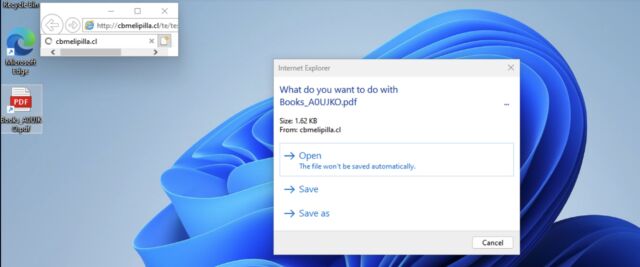
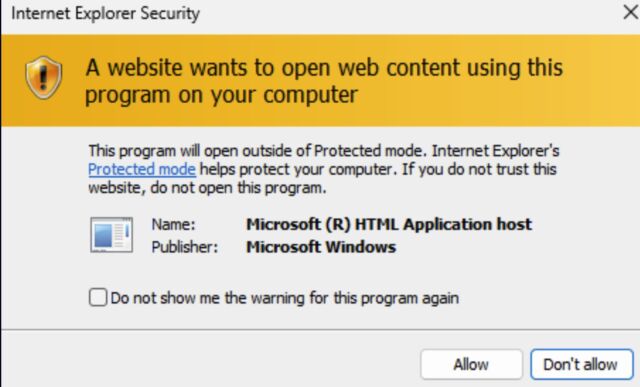
IE would then current the consumer with a dialog field asking them in the event that they needed to open the file masquerading as a PDF. If the consumer clicked “open,” Windows introduced a second dialog field displaying a imprecise discover that continuing would open content material on the Windows machine. If customers clicked “enable,” IE would load a file ending in .hta, an extension that causes Windows to open the file in Internet Explorer and run embedded code.
Check Point
Check Point
“To summarize the assaults from the exploitation perspective: the primary method utilized in these campaigns is the “mhtml” trick, which permits the attacker to name IE as an alternative of the more safe Chrome/Edge,” Li wrote. “The second method is an IE trick to make the sufferer imagine they’re opening a PDF file, whereas in actual fact, they’re downloading and executing a harmful .hta software. The general aim of those assaults is to make the victims imagine they’re opening a PDF file, and it is made doable through the use of these two methods.”
The Check Point publish consists of cryptographic hashes for six malicious .url recordsdata used within the marketing campaign. Windows customers can use the hashes to verify if they’ve been focused.


