
Getty Images
Cloud storage supplier Snowflake mentioned that accounts belonging to a number of customers have been hacked after risk actors obtained credentials by info-stealing malware or by buying them on on-line crime boards.
Ticketmaster guardian Live Nation—which disclosed Friday that hackers gained entry to knowledge it saved by an unnamed third-party supplier—informed TechCrunch the supplier was Snowflake. The live-event ticket dealer mentioned it recognized the hack on May 20, and a week later, a “prison risk actor supplied what it alleged to be Company person knowledge on the market through the darkish internet.”
Ticketmaster is one in every of six Snowflake customers to be hit in the hacking marketing campaign, mentioned unbiased safety researcher Kevin Beaumont, citing conversations with folks contained in the affected corporations. Australia’s Signal Directorate mentioned Saturday it knew of “profitable compromises of a number of corporations using Snowflake environments.” Researchers with safety agency Hudson Rock mentioned in a now-deleted publish that Santander, Spain’s largest financial institution, was additionally hacked in the marketing campaign. The researchers cited on-line textual content conversations with the risk actor. Last month, Santander disclosed a knowledge breach affecting customers in Chile, Spain, and Uruguay.
“The tl;dr of the Snowflake factor is mass scraping has been taking place, however no person seen, and so they’re pointing at customers for having poor credentials,” Beaumont wrote on Mastodon. “It seems a lot of information has gone walkies from a bunch of orgs.”
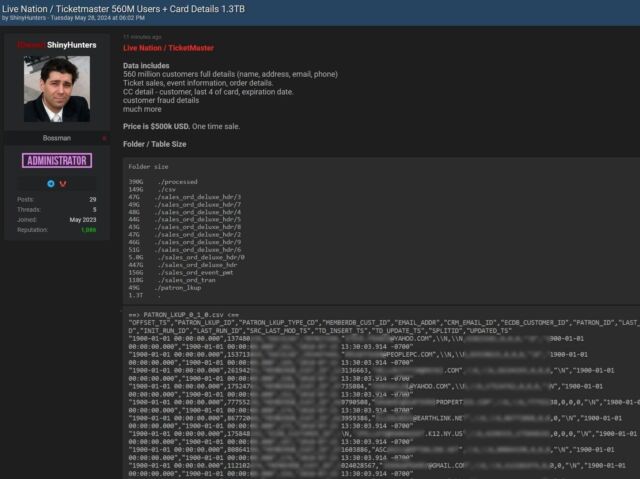
Word of the hacks got here weeks after a hacking group calling itself ShinyHunters took credit score for breaching Santander and Ticketmaster and posted knowledge purportedly belonging to each as proof. The group took to a Breach discussion board to search $2 million for the Santander knowledge, which it mentioned included 30 million buyer data, 6 million account numbers, and 28 million bank card numbers. It sought $500,000 for the Ticketmaster knowledge, which the group claimed included full names, addresses, cellphone numbers, and partial bank card numbers for 560 million customers.
Beaumont didn’t identify the group behind the assaults towards Snowflake customers however described it as “a teen crimeware group who’ve been energetic publicly on Telegram for a whereas and repeatedly depends on infostealer malware to get hold of delicate credentials.
The group has been accountable for hacks on dozens of organizations, with a small variety of them together with:
According to Snowflake, the risk actor used already compromised account credentials in the marketing campaign towards its customers. Those accounts weren’t protected by multifactor authentication (MFA).
Snowflake additionally mentioned that the risk actor used compromised credentials to a former worker account that wasn’t protected by MFA. That account, the corporate mentioned, was created for demonstration functions.
“It didn’t include delicate knowledge,” Snowflake’s notification said. “Demo accounts will not be linked to Snowflake’s manufacturing or company techniques.”
The firm urges all customers to guarantee all their accounts are protected with MFA. The assertion added that customers must also verify their accounts for indicators of compromise utilizing these indicators.
“Throughout the course of our ongoing investigation, now we have promptly knowledgeable the restricted variety of customers who we consider could have been impacted,” the corporate mentioned in the publish.
Snowflake and the 2 safety companies it has retained to examine the incident—Mandiant and Crowdstrike—mentioned they’ve but to discover any proof the breaches are a results of a “vulnerability, misconfiguration, or breach of Snowflake’s platform.” But Beaumont mentioned the cloud supplier shares among the accountability for the breaches as a result of organising MFA on the Snowflake is just too cumbersome. He cited the breach of the previous worker’s demo account as assist.
“They want to, at an engineering and safe by design stage, return and assessment how authentication works—because it’s fairly clear that given the variety of victims and scale of the breach that the established order hasn’t labored,” Beaumont wrote. “Secure authentication shouldn’t be elective. And they’ve acquired to be utterly clear about steps they’re taking off the again of this incident to strengthen issues.”


